
You’ve seen them everywhere — in highway traffic, mall parking lots, maybe even your neighbor’s driveway. Electric vehicles are no longer a concept of the future. They’re right here, right now. But if you’re still wondering what exactly makes a car “electric,” how you charge one, or whether it’s worth the switch — you’re in exactly the right place. This electric vehicle guide covers everything from the basics to the real costs.
What Exactly Is an Electric Vehicle?
If you’re reading this electric vehicle guide, you’re likely curious about making the switch to electric mobility. Let’s get straight to the point. An electric vehicle (EV) is any vehicle powered fully or partially by electricity rather than – or in addition to – a traditional gasoline engine. Instead of burning fuel to create motion, an EV uses one or more electric motors powered by a rechargeable battery pack.
The most obvious difference? You never go to a gas station. You plug in at home overnight, or stop at a public charging station, the same way you charge your phone. That’s the fundamental shift.
But the changes go deeper than just fuel. EVs have far fewer moving parts than gasoline-powered cars, which means less maintenance, fewer things to break, and a fundamentally different driving experience — one that’s remarkably smooth, quiet, and responsive.
|
COMPONENT |
GAS CAR |
ELECTRIC VEHICLE |
|
Power Source |
Gasoline engine |
Electric motor |
|
Fuel |
Gasoline / Diesel |
Electricity |
|
Refuel / Recharge |
Gas station (~5 min) |
Residential EV charging point (overnight or |
|
Moving Parts |
2,000+ parts |
~20 moving parts |
|
Maintenance |
Oil changes, spark plugs, transmission fluid, belts… |
Tire rotation, brake fluid, cabin air filter |
|
Tailpipe Emissions |
CO₂, NOx, particulates |
Zero tailpipe emissions |
|
Acceleration |
Builds up over RPM range |
Instant torque |
For many drivers, switching to an EV means leaving behind some of the most stressful parts of car ownership. No more oil changes, coolant flushes, transmission fluid checks, or timing belt replacements. No more wondering whether your mechanic is recommending a repair you actually need or feeling uncertain at the service counter because you’re not sure what’s really going on under the hood. EVs have far fewer moving parts, which means far fewer things to go wrong.
Beyond the personal relief, there’s a broader benefit too: every mile driven on electricity instead of gasoline means less CO₂ and fewer harmful pollutants released into the air we all share.
In addition, that “instant torque” point is worth noting. Because electric motors deliver maximum torque the moment you press the accelerator, even a modestly priced EV can feel surprisingly quick off the line. It’s one of the most common things new EV owners rave about.
How Does an Electric Vehicle Actually Work?
You don’t need to be an engineer to understand this. Think of it in four key components working together.
🔋Battery Pack – The Fuel Tank
The large lithium-ion battery pack stores all the electrical energy that powers the car. It’s usually mounted flat under the floor of the vehicle, which actually lowers the center of gravity and improves handling. Battery capacity is measured in kilowatt-hours (kWh) — the higher the kWh, the longer the range. A typical modern EV has a battery between 60–100 kWh.
⚙️ Electric Motor – The Engine
The electric motor converts electrical energy from the battery into mechanical energy (movement). Unlike a gas engine, it has no pistons, no cylinders, no exhaust. It’s clean, efficient, and virtually silent. Many EVs have two motors (one per axle) for all-wheel drive.
🔄 Regenerative Braking – Free Energy Recovery
This is the part that surprises most newcomers. When you lift off the accelerator or press the brake, the electric motor reverses its role and acts as a generator — converting your vehicle’s kinetic energy back into electricity and feeding it back into the battery. You’re basically charging for free every time you brake. This is why EVs are especially efficient in city driving with lots of stop-and-go.
🔌 Onboard Charger — The Power Converter
When you plug into a standard outlet or Level 2 charger, the onboard charger converts AC power from the grid into DC power that the battery can store. DC Fast Chargers bypass this step, delivering power directly to the battery — which is why they’re so much faster.
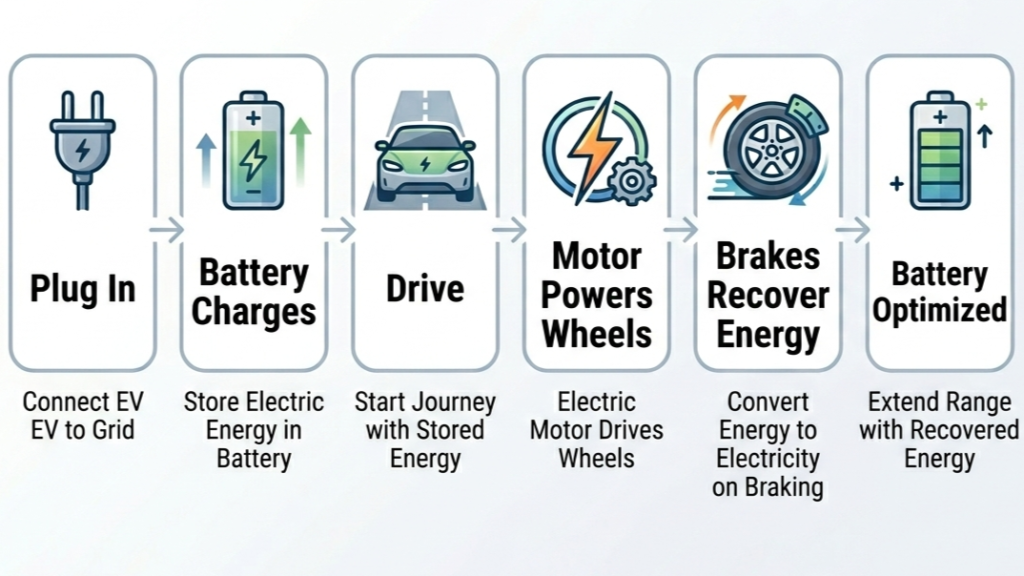
Think of the battery pack like a giant smartphone battery – charge it overnight at home, and it powers your entire day. According to data from the U.S. Department of Transportation, the average American drives just 37 miles (60 km) daily. Most EVs offer 250+ miles (400+ km) of range.
⚡ Wait, What Does This Mean?
- Charging Levels
– Standard Outlet: A regular household socket (110V/220V). It’s the slowest way to charge, often called “Level 1” or “Trickle Charging”.
– Level 2 Charger: A dedicated home or public charging station (240V). It’s much faster and can usually fully charge an EV overnight. - AC vs. DC Power
– AC Power (Alternating Current): Power delivered from the grid. The car’s “onboard charger” must convert AC into DC before storing it in the battery. It’s slower because of this conversion step.
– DC Power (Direct Current): Power provided by “Fast Chargers.” It bypasses the onboard charger and sends electricity directly to the battery. It’s significantly faster because no conversion is needed inside the car.
Not All EVs Are the Same — The 4 Types Explained
“Electric vehicle” is actually an umbrella term covering several different vehicle technologies. Here’s what each one means and who it’s best for.
BEV
Battery Electric Vehicle
100% electric. No gasoline engine whatsoever. Plugs in to charge. Zero tailpipe emissions. The purest form of EV and increasingly the most popular.
Examples: Tesla Model 3, Chevy Equinox EV, Ford F-150 Lightning, Kia EV6, Hyundai Ioniq 6
✅ Best for: Daily commuters with home charging
PHEV
Plug-in Hybrid Electric Vehicle
Has both an electric motor and a gasoline engine. Can be plugged in for 20-50 miles (32-80 km) of electric-only range, then switches to gas for longer trips.
Examples: Jeep Wrangler 4xe, Toyota RAV4 Prime, Chrysler Pacifica Hybrid, Ford Escape PHEV, Toyota Prius Prime
✅ Best for: Frequent long trips + range anxiety concerns
HEV
Hybrid Electric Vehicle
Has a small electric motor that assists the gasoline engine but cannot be plugged in — charges only through regenerative braking. More fuel-efficient than a regular gas car.
Examples: Toyota RAV4 Hybrid, Toyota Camry Hybrid, Honda Accord Hybrid, Toyota Prius
⚠️ Transition option — no home charging needed
FCEV
Fuel Cell Electric Vehicle
Uses hydrogen to generate electricity on board. Emits only water vapor. Infrastructure still very limited -primarily California.
Examples: Toyota Mirai, Hyundai Nexo
🔬 Early adopters – limited to select markets
| TYPE | PLUG-IN? | GAS ENGINE? | ELECTRIC RANGE | BEST FOR |
| BEV | ✅ Yes | ❌ No | 200-400+ miles (320-640+ km) | Most daily urban drivers |
| PHEV | ✅ Yes | ✅ Yes | 20-50 miles (32-80 km) electric, unlimited with gas | Mixed city/ highway driving |
| HEV | ❌ No | ✅ Yes | ~1-2 miles (1.6-3.2 km) only | Fuel savings, no lifestyle change |
| FCEV | ✅ Yes (H₂) | ❌ No | 300-400 miles (480-640 km) | Early adopters, CA residents |
Which EV Technology is Right for You?
Choosing between these four technologies comes down to two simple questions: “Do I want to plug in?” and “Do I still need a gas engine for backup?” BEVs represent the cleanest, most advanced leap forward, offering a completely gas-free life for those with easy access to charging. On the other hand, HEVs and PHEVs serve as excellent “bridge” technologies, providing the fuel efficiency of an electric motor without the “range anxiety” often associated with long road trips or a lack of public chargers. While FCEVs offer a fascinating peek into a hydrogen-powered future, they remain a niche choice primarily for those living near specific infrastructure, like in parts of California.
How Do You Charge an Electric Vehicle?
If you’re still reading this electric vehicle guide, you’re probably ready to understand the reality of fueling your drive. Range anxiety– the fear of running out of charge – is the #1 concern for first-time EV buyers. The good news: once you understand how charging actually works in real life, that anxiety largely disappears.
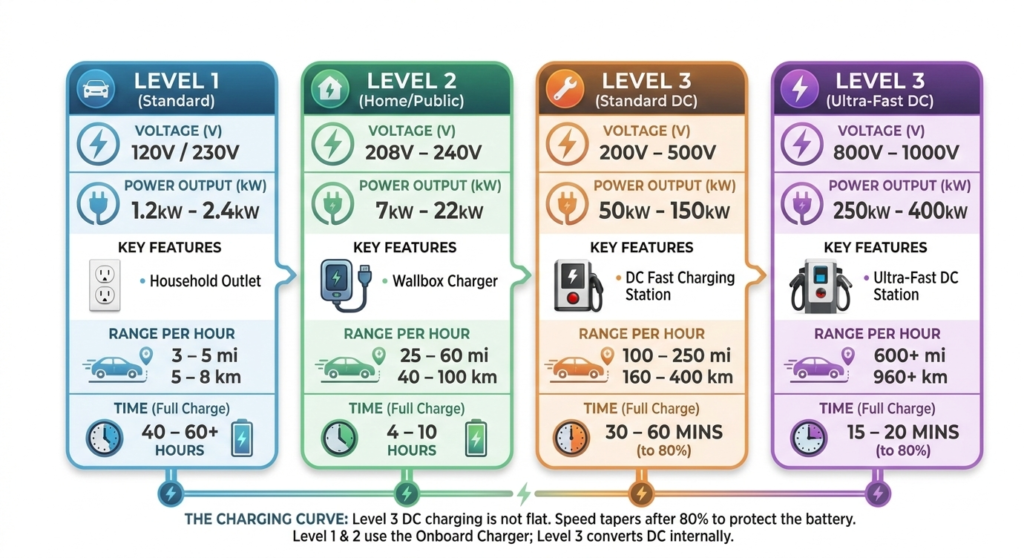
Understanding the different levels of electric vehicle charging is key to optimizing your driving experience. While Level 1 and 2 charging use alternating current (AC) typically found at home, Level 3 provides direct current (DC) for significantly faster speeds on the road. Standard Level 3 chargers usually offer up to 150kW, but ultra-fast stations can reach over 250kW, drastically reducing wait times. It is important to note that DC charging speeds naturally taper off after 80% to protect and prolong your battery’s health. Ultimately, choosing the right charging level depends on your vehicle’s architecture and whether you need a slow overnight top-up or a quick highway boost.
3 Key Factors Affecting Your Real-World Charging Speed
While the technical specifications of charging levels provide a solid foundation, your daily experience behind the wheel often tells a more nuanced story. Factors like battery temperature, state of charge, and even local grid conditions can influence how quickly you get back on the road.
It is essential to recognize that charging isn’t always a constant flow of power. Here are the three most critical factors that determine how quickly you can get back on the road.
- Battery State of Charge (SoC) and the Charging Curve
Just like a sponge absorbs water quickly when dry but slows down as it becomes saturated, an EV battery charges fastest when the SoC is low. As the battery reaches 80% capacity, the Battery Management System (BMS) intentionally reduces the power intake to protect the internal cells from overheating and degradation. - Ambient Temperature and Battery Thermal Management
Lithium-ion batteries are sensitive to extreme temperatures, which can significantly impact charging efficiency. In very cold or excessively hot weather, the vehicle may limit charging speeds to safeguard the battery’s longevity, making pre-conditioning your battery a vital step for optimal performance. - Charging Station Capacity and Onboard Charger Limits
Your charging speed is often limited by the “weakest link” in the connection. While a DC fast charger might be rated for 350kW, your vehicle will only draw the maximum power its onboard charger or battery architecture (such as 400V vs. 800V) can safely handle.
The practical impact of these factors is that your actual charging time will often vary from the theoretical “peak speeds” advertised by manufacturers. Recognizing that a 350kW charger might only deliver its maximum output during a specific window of the charging curve—and that cold weather or a high state of charge can naturally extend your wait—is the first step toward a smoother journey.
By accounting for these variables, you can plan your stops more strategically, such as aiming for a quick “splash and dash” between 10% and 80% rather than waiting for a slow 100% full charge. To get the best out of this strategy, remember that pre-conditioning your battery is like warming up your muscles before a heavy workout. It ensures your battery is ready to absorb energy at its maximum capacity the moment you plug in. Finally, keep in mind that the most expensive charger doesn’t always guarantee the fastest results, so always make sure to check your vehicle’s Max DC Charging Rate before plugging in.
Understanding these technical realities transforms charging from a source of stress into a manageable part of your routine. When you can anticipate how your battery behaves in different conditions, you gain true control over your travel schedule, effectively eliminating the fear of the unknown and reducing range anxiety for good.
What Does an Electric Vehicle Actually Cost in 2026?
If you’re considering an electric vehicle this year, you’ve likely noticed that the conversation has changed. The “wild west” of massive upfront tax credits from a few years ago has evolved into a more nuanced financial landscape. In 2026, understanding the cost of an EV isn’t just about the sticker price—it’s about knowing which old perks have vanished and which new opportunities have taken their place.
The 2026 Incentive Landscape: What’s New?
The headline for 2026 is a major shift in federal support. Many of the direct purchase credits that defined the early 2020s have been phased out, but new specialized benefits have emerged.
❌ What has Expired: The End of the “Point-of-Sale” Purchase Credits
For most new buyers in 2026, the primary federal tax credits that once defined the EV market are no longer available for new transactions.
- The $7,500 New Clean Vehicle Credit (30D): Direct point-of-sale credits for new EVs are no longer available for vehicles acquired after late 2025.
- The $4,000 Used EV Credit (25E): Much like the new vehicle credit, the federal incentive for pre-owned EVs also concluded in late 2025.
- The “Lease Loophole”: The previous commercial credit (45W) that allowed dealers to pass $7,500 in savings to lessees regardless of battery sourcing has also been phased out for most personal-use consumer leases.
✅ What’s Still Available: Remaining Federal & Local Savings
While the big “sticker price” credits are gone, 2026 still offers several ways to make your EV transition more affordable.
- The $10,000 Loan Interest Deduction: This is the big winner for 2026. If you purchase a new, U.S.-assembled EV for personal use, you may be eligible to deduct up to $10,000 in loan interest over the life of your financing.
- Home Charging Infrastructure Credit (Section 30C): If you install a home charger before June 30, 2026, you can still claim a tax credit of 30% (up to $1,000). Note: This is now restricted to eligible “non-urban” or underserved census tracts.
- State & Local Rebates: While federal credits have slimmed down, states like Colorado (up to $9,000 rebate) and California continue to offer aggressive incentives that often bridge the gap left by federal changes.
- Utility Incentives: Many power companies now offer “Off-Peak” charging rates or even direct rebates for smart-charger installations to help manage grid load.
EV Market Segmentation: 2026 Price Guide
Despite the loss of federal point-of-sale credits, manufacturers have lowered MSRPs (Manufacturer’s Suggested Retail Prices) to stay competitive. Here is how the market breaks down today.
ENTRY LEVEL
$25K-$40K
Nissan Leaf (Next-Gen), Chevy Equinox EV, Kia EV3, Hyundai Kona Electric
MID RANGE
$40K-$75K
Tesla Model Y, Hyundai Ioniq 5, Kia EV9, Ford Mach-E, Volvo EX 30
PREMIUM
$75K+
Lucid Gravity, Rivian R1S, Porsche Taycan, BMW i7, Rivian R1S, Cadillac Escalade IQ
Source: 2026 U.S. EV Market Outlook & OBBBA (One Big Beautiful Bill Act) Guidelines.
The 2026 EV market offers a diverse range of choices tailored to every driver. Entry-level models like the Nissan Leaf and Kia EV3 are finally making 250 miles (400km) of range accessible for under $35,000. The Mid-range segment is dominated by ultra-fast 800V charging and family-ready SUVs like the Ioniq 5 and Kia EV9. The Premium tier, led by the Lucid Air and Cadillac Escalade IQ, is redefining luxury through industry-leading aerodynamics and high-tech cabin experiences. Whether you prioritize affordability, versatile family utility, or cutting-edge performance, there is now an electric vehicle that fits both your lifestyle and your budget.
Long-Term Savings: The “Real” Math
While the upfront credits have changed, the long-term ownership math for EVs in 2026 remains incredibly strong.
- Fuel Stability: While gas prices continue to fluctuate, charging an EV remains significantly cheaper. On average, fueling with electricity costs the equivalent of $1.20 to $1.50 per gallon.
- The 100-Mile Rule: To drive 100 miles (160km), a gas car costs you about $13–$15. Your EV does the same trip for about $5.00 – the price of a single Starbucks latte.
- Maintenance “Dividend”: With roughly 90% fewer moving parts than a gas engine, EV owners in 2026 are reporting 40% lower scheduled maintenance costs. No oil changes, fewer brake replacements (thanks to regenerative braking), and no complex transmission repairs.
- Resale Value: As the “off-lease” market surges in 2026, we are seeing high demand for certified pre-owned EVs with remaining battery warranties, helping stabilize the total cost of ownership.
In 2026, the “best deal” isn’t found in a single federal credit. It’s found by combining the new loan interest deduction with local utility rebates and the massive long-term fuel savings. The upfront cost may feel higher, but the “price parity” (where an EV becomes cheaper than a gas car) usually hits within just 3 years of driving.
Top 5 EV Myths – Busted
EV misinformation is widespread. Let’s address the most common concerns directly, with real numbers.
|
❌ |
Myth #1“EVs can’t go far enough — I’ll always be stranded.”📍Reality: Most 2026 BEVs now offer a standard range of 300–400 miles (480–640 km), with premium models even pushing beyond 500 miles (805 km). Meanwhile, the average American still drives just 37 miles (60 km) per day. This means you could effectively go more than a week without needing to charge. For longer road trips, the latest DC fast chargers can now add 200+ miles (320+ km) of range in as little as 15–20 minutes, making charging stops shorter than a typical coffee break. |
|
❌ |
Myth #2“Charging takes way too long to be practical.”📍Reality: 80–90% of charging happens at home overnight while you sleep. For road trips, the latest 350kW+ chargers add 200+ miles (320+ km) in just 15–20 minutes—exactly the time it takes to grab coffee and use the restroom. This is a different routine than gas, not a worse one. |
|
❌ |
Myth #3“EVs are only for wealthy people.“📍Reality: New entry-level models like the Chevy Equinox EV now start around $35K, becoming even more affordable through the new $10K loan interest deduction. The secondary market is also booming, with reliable pre-owned EVs now available for between $15K and $22K. Even without the old upfront tax credits, the combination of lower MSRPs and massive fuel savings makes price parity achievable within just three years. Ultimately, the surge of affordable new models and a robust used market has officially made electric mobility accessible to everyone. |
|
❌ |
Myth #4“The battery will die in a few years and cost a fortune to replace.”📍Reality: Federal law still mandates a minimum warranty of 8 years or 100K miles (160K km), but many 2026 models such as Hyundai, Kia, and Toyota now offer extended manufacturer warranties up to 10 years or 150K miles (240K km). Real-world data shows that modern LFP (Lithium-Iron-Phosphate) and advanced NMC (Nickel-Cobalt-Manganese) batteries retain over 90% of their capacity even after surpassing the 100K mile (160K km) mark. Furthermore, the rise of modular repairs and certified remanufactured packs has brought battery replacement expenses for many mainstream EVs down to a more manageable $5,000–$9,000 range in 2026. |
|
❌ |
Myth #5“There aren’t enough chargers — the infrastructure isn’t ready.”📍Reality: As of early 2026, the U.S. has expanded its public charging network to over 250K ports, making chargers as common as gas stations in many areas. Under the federal NEVI program, high-speed charging hubs are now strategically placed every 50 miles (80 km) along major highway corridors. Tesla has also opened its massive Supercharger network – now exceeding 36K stalls in North America – to almost all other EV brands. This transition was made seamless as most manufacturers, including Hyundai, Kia, and Toyota, have fully adopted the NACS (North American Charging System) standard. While some rural gaps remain, the infrastructure now easily supports both daily commutes and long-distance road trips for the average driver. |

Source: U.S. Department of Energy – Alternative Fuels Data Center
Is an Electric Vehicle Right for You?
There’s no one-size-fits-all answer, but these practical factors will quickly help you figure out which camp you’re in.
✅ An EV Probably Fits Your Life If…
- Your daily commute is under 150 miles (240 km): Most modern EVs comfortably handle an average daily driving range of up to 150 miles (240 km) without needing a mid-day charge.
- You have reliable “Home Base” charging: You have a garage, driveway, or a dedicated spot at your apartment complex where a Level 2 charger can be installed, allowing you to wake up to a full battery every morning.
- Your routine includes “Third Space” charging: You spend time at locations that increasingly offer charging infrastructure, such as your workplace, gym, or local shopping malls.
- You are focused on Total Cost of Ownership (TCO): You want to capitalize on significantly lower long-term fuel and maintenance costs, as EVs have only about 20 moving parts compared to the 2,000+ found in gas cars.
- You value a premium, high-tech driving experience: You prefer a ride that is quieter, smoother, and more responsive, featuring instant torque and the latest software-driven capabilities.
- You are ready for the new “Entry Level” market: You are looking to take advantage of government tax credits and a wider selection of affordable models now priced between $25,000 and $40,000.
⚠️ You May Want to Wait or Choose PHEV If…
- You live in an apartment without accessible “Overnight” charging: If your residence lacks a dedicated Level 2 charger or a reliable community charging solution, the convenience of EV ownership may be significantly diminished.
- Your daily work routine consistently exceeds 300+ miles (480+ km): A PHEV or a high-efficiency Hybrid may still be more practical for your demanding schedule.
- You reside in or frequently travel to remote rural “Charging Deserts”: If your primary routes are in deep rural areas, the peace of mind of a backup gas engine is invaluable.
- Your budget is strictly under $20k with no flexible financing: If your immediate budget is extremely tight and the local used inventory doesn’t meet your needs, a traditional or hybrid vehicle might be a safer financial choice.
- You regularly tow heavy loads (10,000+ lbs or 45+kg) over long distances: Towing significantly reduces range and increases the frequency of charging stops, which can be cumbersome on long-haul trips compared to a PHEV or Diesel alternative.
For the majority of drivers worldwide, an EV is already a seamless fit for daily life. Much of the hesitation we feel is psychological rather than practical—it’s about adapting to a new routine, not accepting a lesser one. While charging access remains a challenge for those without dedicated home parking, the global push toward workplace charging and robust public networks is rapidly closing that gap.
Beyond Borders: Tracking Future Mobility
You now have a solid foundation—from understanding how an EV works to deciding if it fits your life. We hope this electric vehicle guide has made your transition to electric driving easier. But the journey doesn’t end here.
The EV market moves fast, with new models and infrastructure appearing every month. From our Asian perspective, we don’t just watch the local road. We keep a close eye on the global trends that shape what we drive, what batteries cost, and where the industry is headed. This global lens is exactly what makes EV for Everyone different.
Let’s navigate this electric future, together.